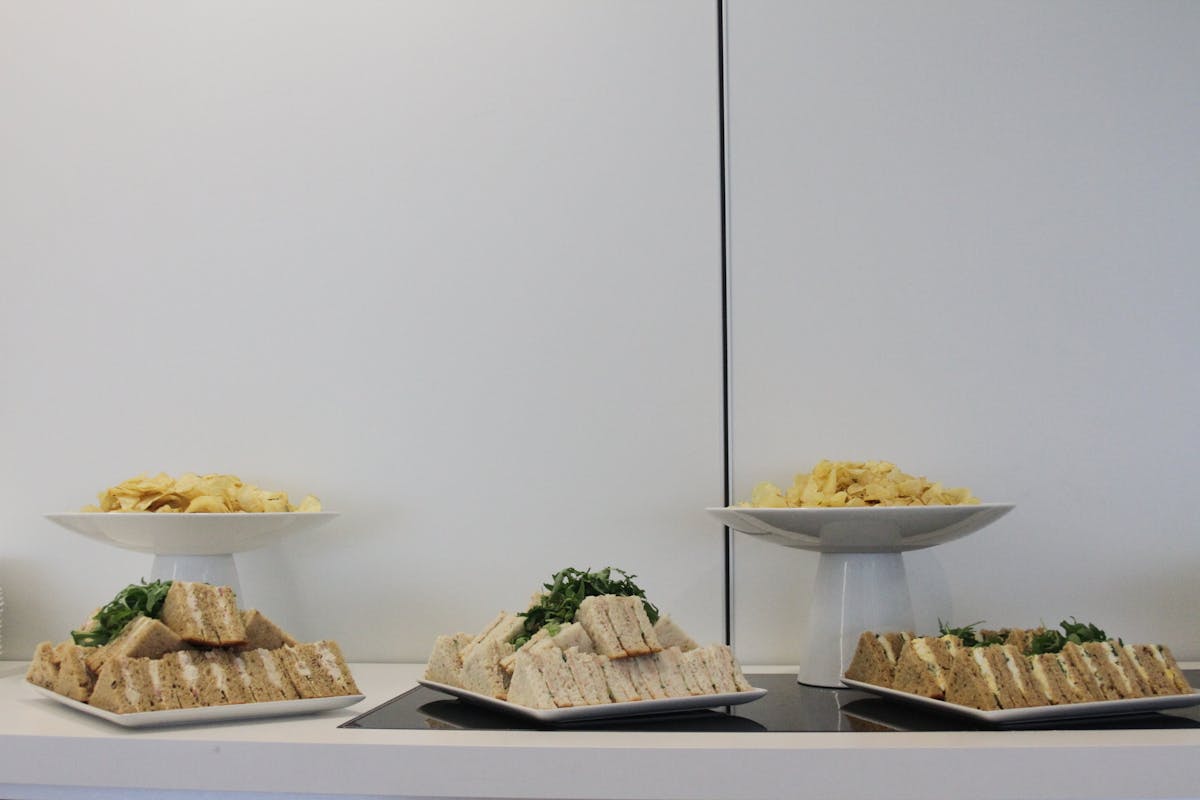
The fundamental split: open or closed
The deepest division in sandwich taxonomy is between the open-faced and the closed. An open-faced sandwich uses a single base, bread, cracker, toast, blini, with toppings arranged on top, eaten with a fork or carefully by hand. A closed sandwich encloses its filling between two surfaces of bread, designed to be picked up and eaten without utensils.
The open-faced tradition runs deep in northern Europe. The Danish smørrebrød is the canonical example: dense rye bread layered with herring, liver pâté, roast beef, or shrimp, garnished with herbs and pickles. The Swedish smörgås and Norwegian smørbrød are close cousins. In France, the tartine serves a similar function. The American versions, avocado toast, ricotta toast, the bagel-and-lox open-face, are recent imports of the same idea.
Closed sandwiches dominate the rest of the world. The hand is the utensil; the bread is the wrapper.
Cold vs. hot
A cold sandwich relies on cured, pickled, or cooked-then-cooled ingredients. The classic deli sandwich, pastrami on rye, turkey club, ham and Swiss, is built cold and eaten cold. The flavors are clean and distinct. The textures are firm.
A hot sandwich introduces heat as a fundamental ingredient. Heat melts cheese, crisps bread, warms fillings, releases aromas. The grilled cheese, the patty melt, the French dip, the Italian beef, the Philly cheesesteak, these only make sense hot. A cold cheesesteak is a sad object.
Some sandwiches straddle the line. The Cubano is built from cooked-then-cooled ingredients, then pressed and heated. The bánh mì layers cold pickled vegetables on warm grilled meat. The best sandwiches often play hot and cold against each other.
Pressed sandwiches
Pressing a sandwich, applying weight and heat simultaneously, fundamentally transforms it. The bread crisps and compresses. The cheese melts and binds. The fillings meld into a single integrated object. The pressed sandwich is denser per cubic inch than its unpressed equivalent, with more flavor per bite.
The Italian panini is the most familiar example, but the technique is global. The Cuban Cubano is pressed on a plancha. The Brazilian misto quente is pressed in a cast-iron sandwich maker. The French Croque Monsieur is essentially a pressed sandwich, though it is finished under a broiler rather than between two hot surfaces. The Japanese hot sando maker, a clamshell device, produces sealed, crustless pressed sandwiches eaten as a snack.
Stuffed and rolled
The stuffed sandwich uses bread as a vessel rather than a wrapper. A pita stuffed with falafel. A baguette hollowed out and packed with fillings. The Indian vada pav, a fried potato dumpling crammed inside a soft bun. The Italian piadina folded around prosciutto and arugula.
The rolled sandwich takes a thin, flexible bread and wraps it around the filling. The wrap, the burrito, the gyro, the shawarma, the Vietnamese bánh xèo. Whether all of these qualify as sandwiches depends on your definitional generosity (see: definition debate). For our purposes, they are sandwich-adjacent and worth including.
Stacked
The stacked sandwich is the showpiece category, multi-layer constructions that demand toothpicks or skewers to hold them together. The American club sandwich (three slices of bread, two layers of filling) is the canonical stack. The Dagwood, named for the comic-strip character Dagwood Bumstead, is the absurdist extreme, a tower of meats, cheeses, and condiments that defies physics and the human jaw.
The Uruguayan chivito is a stacked sandwich at its most ambitious: steak, ham, bacon, mozzarella, lettuce, tomato, fried egg, and olives, all on a soft bun. Eating one is a project.
The bread defines the type
A useful secondary taxonomy is by bread vehicle. The roll-based sandwich, hoagie, sub, hero, grinder, uses a long crusty roll. The slice-based sandwich uses two pieces of standard pan-baked bread. The flatbread sandwich uses pita, naan, lavash, or tortilla. The bun-based sandwich uses a soft enriched roll, often split horizontally. The bagel sandwich is its own category, defined by the dense chewy ring.
Each bread imposes its own structural logic. A baguette can take wet fillings without collapsing because its crust is rigid. A soft pan-bread cannot, it needs a moisture barrier. A pita's pocket allows for chunky fillings that would fall out of a flat sandwich. The bread is not a neutral container. It is the structural engineering of the entire object.
A working classification
A reasonable taxonomy looks like this: along one axis, the temperature (cold, hot, pressed). Along another, the structure (open, closed, stuffed, rolled, stacked). Along a third, the bread vehicle (slice, roll, flatbread, bun, bagel). Any sandwich can be located in this three-dimensional space. The Reuben is a hot, closed, slice-based sandwich. The bánh mì is a cold-and-hot, stuffed, roll-based sandwich. The smørrebrød is an open, cold, slice-based sandwich.
This is more taxonomy than most people need to eat lunch. But it explains why the sandwich category feels so vast: there are at least three independent dimensions of variation, and almost every combination has been invented somewhere.