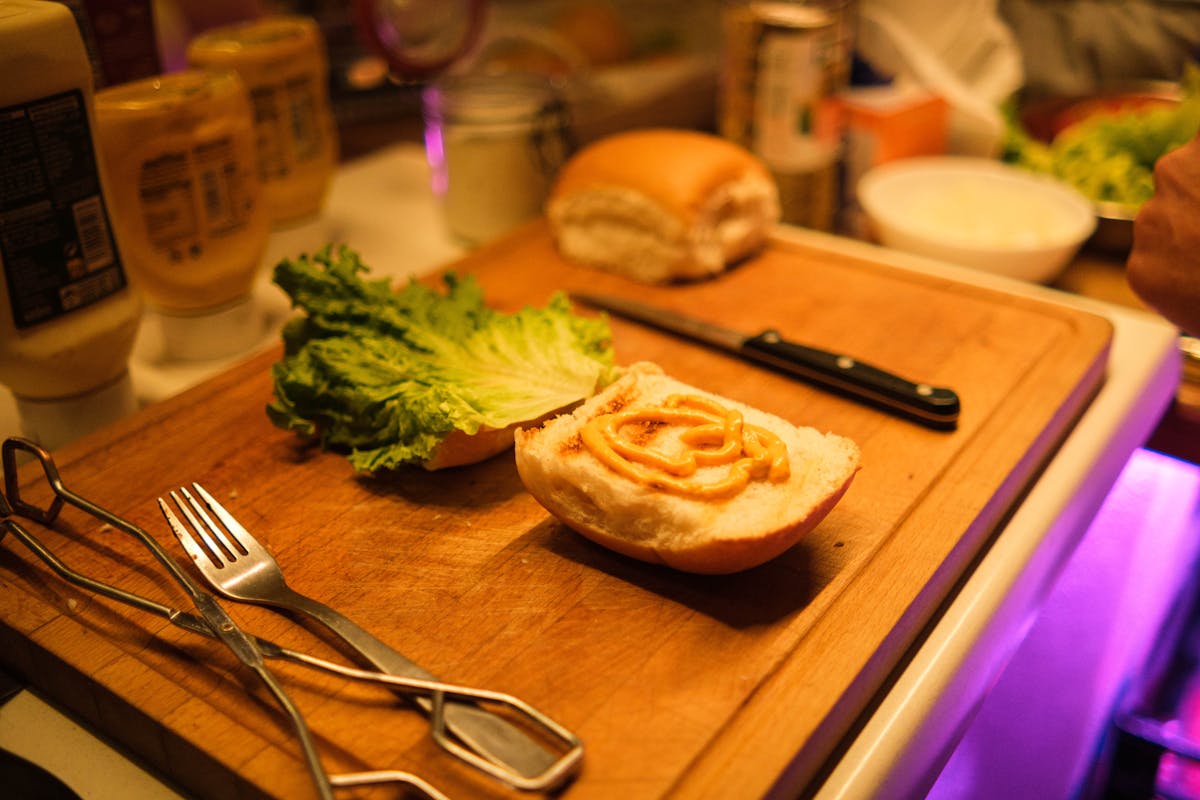
Start with the bread
A sandwich is mostly bread, by volume and by weight. If the bread is bad, the sandwich is bad. There is no recovery from this. You can have the finest charcuterie, the freshest produce, the most carefully made aioli, and if you put it on supermarket pan loaf, you will produce a mediocre sandwich.
Match the bread to the filling. A wet, dressing-heavy filling needs a sturdy crusted bread that can absorb moisture without falling apart, a ciabatta, a sourdough boule, a baguette. A delicate filling, cucumber and butter, smoked salmon, wants a soft, fine-crumbed bread that does not overpower it. A grilled sandwich needs a bread that holds its structure under heat: brioche, pain de mie, a country sourdough. Avoid bread that is too holey for slice-based sandwiches, fillings escape through the holes.
Buy bread the day you eat it, when possible. Day-old bread is fine for toasting. Three-day-old bread is fine for a panzanella. Five-day-old bread is fine for ducks. Sandwich bread should be fresh.
The moisture barrier
The single most important principle in sandwich construction is the moisture barrier. Wet ingredients, tomato, pickles, dressing, mayonnaise applied to one side only, will turn bread into mush within minutes. The fix is to wrap the wet ingredients in fat or fat-rich layers.
In practice: spread mayonnaise (or butter, or aioli, or any fat-based spread) on both slices of bread, completely covering the surface that will contact the filling. The fat creates a hydrophobic seal. Water cannot pass through. The bread stays dry. The sandwich, hours later, is still structurally sound.
The second tier of moisture management: place high-moisture ingredients between low-moisture ones. Tomato should not touch bread. Tomato should sit between cheese and lettuce, or between two slices of meat. The dry layers protect the bread. This is why a properly built BLT puts lettuce against the bread and tomato in the middle, not the other way around.
Stacking order matters
The order of layers is not aesthetic. It is structural and sensory. The first ingredient you taste is the one closest to your tongue, which is the one on top when you flip the sandwich to bite it. The cheese should be against the bread for melted sandwiches, so it bonds the layers. The protein should be in the middle for cold sandwiches, distributed evenly so every bite contains it.
A reliable order for a cold layered sandwich, bottom to top:
- Bottom slice of bread
- Spread (mayo, mustard)
- Cheese (to protect the bread from moisture)
- Protein (meat, fish)
- Crunchy vegetable (lettuce, sprouts)
- Wet vegetable (tomato, pickle)
- Aromatic (onion, herbs)
- Spread (mayo, mustard)
- Top slice of bread
The principle: dry against bread, wet in the middle, alternating textures throughout.
Salt at every layer
Professional cooks salt their food at every stage of preparation. Sandwich-makers, mostly, do not. This is a mistake. Each individual ingredient should be seasoned before it goes onto the bread. The tomato should be salted (which also draws out moisture, see the arguments section). The avocado should be salted and lemoned. The lettuce, lightly. The protein, generously.
A single layer of salt at the end, a sprinkle on top before closing, does not penetrate. By the time the sandwich is assembled and bitten, the salt has only flavored the outermost layer. Distributed seasoning is what separates a forgettable sandwich from a memorable one.
The protein-to-vegetable ratio
The American instinct is meat-forward: pile on the protein, treat vegetables as garnish. The European and Asian traditions tend toward balance, equal parts meat and vegetable, both treated as central. The bánh mì is the textbook example: roughly equal volumes of grilled pork, pickled daikon and carrot, cucumber, and herbs.
The meat-heavy sandwich is rich and satisfying for the first three bites and then becomes monotonous. The balanced sandwich sustains interest from start to finish. Vegetables provide acid, crunch, and freshness, all of which cut through fat and protein and reset the palate between bites.
Cut diagonally, always
The diagonal cut is not aesthetic preference. It is engineering. The diagonal slice produces a longer cut face, which exposes more interior cross-section to view. This is why every restaurant sandwich is diagonally cut: it photographs better, looks more generous, and presents the fillings as if you are about to receive a small architectural feat.
Functionally, the diagonal cut also produces a thinner leading edge, a point, that is easier to bite into than a flat squared end. Your first bite into a diagonally cut sandwich is small and inviting. Your first bite into a straight-cut sandwich is a full-mouth confrontation.
Press, even briefly
Even a sandwich not destined for a panini press benefits from being pressed for thirty seconds before serving. Wrap it tightly in parchment, press a plate on top, and let it sit. The layers compress, the flavors begin to meld, the bread shapes itself around the filling. The sandwich becomes more itself.
This is the secret behind the famous "the sandwich is better the next day" phenomenon. Time and pressure unify a sandwich the way reduction unifies a sauce. You cannot wait twelve hours, but you can wait two minutes, and two minutes makes a difference.
Eat it standing up, over the sink
The best sandwiches are slightly messy. They drip. They shed crumbs. They demand a bib or, failing that, a permissive setting. The clean sandwich is usually the boring sandwich. The sandwich that requires you to lean forward and eat with intention is the one worth eating.