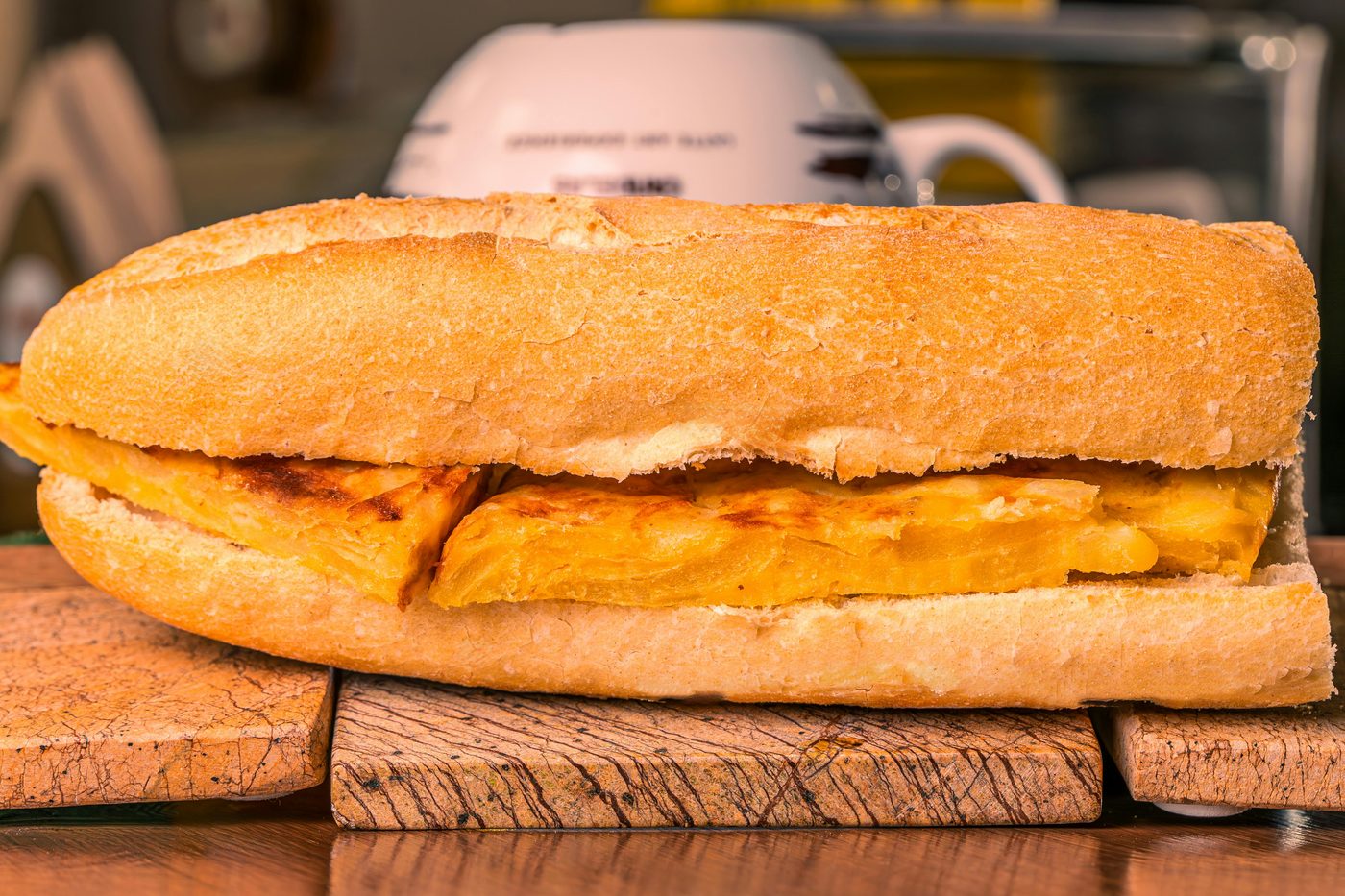
The Maillard reaction and the case for toast
When bread is toasted or grilled, something more than dehydration is happening. The amino acids in the bread's proteins react with the reducing sugars in its starches at high heat, producing hundreds of new flavor compounds. This is the Maillard reaction, named for the French chemist Louis-Camille Maillard, who first described it in 1912.
The Maillard reaction is responsible for the brown crust on bread, the sear on a steak, the color of roasted coffee, and the flavor of dark chocolate. It is not the same as caramelization, which involves only sugars. Maillard chemistry produces a much wider spectrum of compounds, pyrazines (nutty, roasted), furans (caramelly, sweet), thiophenes (meaty, savory).
A grilled cheese sandwich gets its flavor from Maillard chemistry on both sides of the bread. A pressed Cubano gets its character from Maillard browning on a hot plancha. A piece of plain white toast tastes radically more interesting than the same bread untoasted, and the difference is entirely Maillard.
The reaction proceeds optimally between 280°F and 330°F (140°C–165°C). Too cool, and the bread dries before it browns. Too hot, and the bread burns before the interior heats. This is why a moderate medium-low heat produces the best grilled cheese, the cheese has time to melt while the bread browns evenly.
Salt and the perception of flavor
Salt does not just taste salty. Salt actively suppresses bitterness, enhances sweetness, and amplifies almost every other flavor on the palate. A sandwich without salt tastes flat. The same sandwich with appropriate salt tastes vivid.
The mechanism is partly chemical (sodium ions interact with taste receptors) and partly perceptual (salt suppresses the palate's bitter response, allowing other flavors to register more clearly). This is why bland tomatoes taste better when salted, why unsalted butter tastes like nothing, and why undersalted soup is the most common cooking error in the world.
For sandwiches, salt should be applied at every layer where flavor matters. Cured meats are pre-salted, but tomatoes, avocado, lettuce, and most spreads benefit from a light additional season. The total sodium load adds up, you are not aiming to make any single layer aggressively salty, only to bring each one to its proper register.
Texture contrast and bite satisfaction
There is a body of food science research suggesting that the most pleasurable foods combine multiple textural sensations in a single bite. The crunch of toast against the soft yield of egg salad. The shatter of fried chicken skin against pickled jalapeño against soft milk bread. The crisp lettuce against tender turkey against squishy bread.
This is sometimes called the "contrast principle" in sensory science. A monotextural food, pudding, mashed potato, plain bread, is satisfying in small quantities but quickly becomes tedious. A multi-textural food sustains interest. The brain registers each bite as fresh information.
The great sandwiches of the world all exhibit textural complexity. The bánh mì has at least five distinct textures (crisp baguette crust, soft baguette interior, soft meat, crunchy pickled vegetables, fresh herbs). The katsu sando has three (soft milk bread, crunchy panko, tender pork). The Reuben has four (crisp griddled rye, melted cheese, soft corned beef, briny sauerkraut).
A sandwich with only one or two textures feels incomplete, even if you cannot articulate why.
Umami stacking
Umami, the fifth basic taste, distinct from salty, sweet, sour, and bitter, was identified by the Japanese chemist Kikunae Ikeda in 1908. It corresponds to the presence of glutamate, an amino acid found in high concentrations in aged cheese, cured meats, mushrooms, tomatoes, soy sauce, fish sauce, fermented vegetables, and seaweed.
Umami compounds are synergistic. A sandwich containing two or more umami sources tastes much more savory than the sum of its parts. This is why a tomato-and-cheese sandwich tastes more substantial than a cheese sandwich alone, and why adding a few drops of soy sauce or Worcestershire to a sandwich filling can dramatically boost flavor.
The umami champions of the sandwich world: the Reuben (corned beef + Swiss + sauerkraut), the Italian sub (cured meats + provolone + olive oil + tomato), the Vietnamese bánh mì (pâté + grilled pork + pickled vegetables + Maggi sauce). Each layer is contributing glutamate. Each layer is amplifying the others.
The practical takeaway: when a sandwich tastes "flat" despite being correctly seasoned, it is often missing umami. A slice of aged cheese, a brush of fish sauce, a smear of miso, a few sun-dried tomatoes, any of these will lift the entire structure.
The physics of the bite
At the moment of biting, a sandwich is subjected to compression. The teeth converge on the sandwich and apply force from above and below. A well-engineered sandwich resists this force evenly, allowing the teeth to slice through cleanly. A poorly engineered sandwich does one of two things: either the bread compresses faster than the filling (squirting filling out the back), or the filling slides while the bread holds (resulting in a mouthful of bread and a sandwich now empty).
Filler stickiness, achieved through fats and emulsifiers (mayonnaise, melted cheese, butter), helps glue layers in place. Slippery fillings without binders, sliced ham on plain bread, for example, slide. This is why mayonnaise is a structural ingredient as well as a flavor one. It is glue.
The pressed sandwich solves the bite problem by force. Pressing compresses the entire object into a single block before the eater encounters it. The bread, cheese, and meat have already merged. There is no stratification to misbehave. The bite is clean.
Temperature and aroma release
Warm food releases more aroma compounds than cold food. The volatile molecules that we perceive as smell, and that contribute the majority of what we register as "flavor", evaporate more readily at higher temperatures. This is why cold pizza tastes like nothing compared to hot pizza, even when the ingredients are identical.
A hot sandwich, even one that contains the same ingredients as a cold one, will taste more flavorful. The melted cheese releases dairy aromas. The warmed bread releases yeasty toasted notes. The hot meat releases its fats and meaty volatiles into the air, where they reach the back of the nose during chewing (this is retronasal olfaction, which provides most of "taste").
This is also why a sandwich freshly made tastes better than one packed an hour ago and eaten cold from a lunchbox. The cold sandwich has lost much of its aroma to the air. The fresh sandwich is still fragrant. Eating sandwiches at room temperature, rather than refrigerator-cold, restores some of this lost dimension.