Technique & Craft

Advanced
Sandwich
Techniques

The difference between a good sandwich and an extraordinary one is usually technique — not ingredients. 20 methods explained with the science behind each one.

14 Easy | 5 Medium | 1 Hard | Browse all ↓
Sandwich making techniques

Most sandwich recipes tell you what to put between the bread. Technique tells you how to prepare each component at the level where the real difference is made. The smash that happens in the first five seconds of cooking a burger patty. The brine that sits overnight and changes the cellular structure of the chicken. The caramelization that takes 45 minutes and cannot be rushed. Understanding the science behind each technique is what converts a cook who follows recipes into one who makes decisions.

The Smash

Easy
Smash Burgers Beef Patties

The smash technique is the defining method of the best burger movement of the past decade, and its logic is completely counterintuitive to anyone trained to handle burgers gently. You take a ball of loosely packed ground beef — never a formed, compacted patty — place it on a ripping-hot flat surface, and smash it immediately and aggressively with a heavy spatula, creating maximum contact between meat and metal. The result is a thin, lacy-edged patty with a crust so deep and aggressive it almost resembles bark. This is not the way to cook a thick, steakhouse burger. It is the way to cook a fast, perfect, intensely flavored thin-patty burger.

Step by Step
  1. 1 Heat cast iron or flat griddle to 450–500°F — the surface should be smoking
  2. 2 Form a 2–3 oz ball of 80/20 ground beef, loosely packed — do not compress it
  3. 3 Place the ball on the hot surface
  4. 4 Immediately smash with a heavy spatula or burger press, using firm, steady pressure for 10 seconds
  5. 5 Season the exposed top surface with salt and pepper
  6. 6 Cook undisturbed for 60–90 seconds — you will see the edges begin to brown
  7. 7 Scrape and flip in one clean motion — you want the entire crust to release at once
  8. 8 Add cheese immediately to the hot side
  9. 9 Cook 30 more seconds and remove
The Science

The Maillard reaction — the chemical process responsible for the browned, complex crust flavor — requires sustained contact between protein and a hot surface. A thick burger has a round shape that makes only limited contact with the pan; a smashed patty is almost entirely flat against the surface, maximizing the area undergoing Maillard browning. The loose ball of beef also means the fat is not compressed together, so when smashed, the fat distributes through the patty as it cooks rather than being squeezed out. 80/20 ground beef (80% lean, 20% fat) is the standard because the fat is what carries flavor and keeps the thin patty moist.

Common Mistakes
  • × Not getting the pan hot enough before adding the meat — you need visible smoke
  • × Waiting to smash — you have approximately 5 seconds after placement before the proteins begin to set
  • × Smashing more than once — one firm press is correct; repeated smashing compresses the meat unnecessarily
  • × Using lean ground beef — less than 80/20 produces a dry, flavorless smash patty
  • × Moving or checking the patty before it releases naturally from the surface
Pro Tip

Place a small square of parchment paper between the spatula and the meat before smashing — it prevents sticking and allows you to apply more pressure without the meat adhering to the spatula.

Butterflying Chicken Breast

Easy
Chicken Sandwiches Grilled Chicken Chicken Melts

Butterflying a chicken breast — cutting it horizontally to create two thinner, even pieces from one thick one — is the fastest and most reliable way to solve the fundamental problem of cooking chicken breast: the thickness differential that leads to dry edges and undercooked centers. A standard chicken breast might be 3/4 of an inch thick in the center and 1/4 inch at the tapered end. Butterfly it and you have two pieces of roughly equal thickness that cook simultaneously and evenly. For sandwich applications, butterflied chicken also fits bread proportions better — a full chicken breast overhangs a standard roll on every side; a butterflied half sits neatly within the bread footprint.

Step by Step
  1. 1 Place the chicken breast on a cutting board with the thick end toward your dominant hand
  2. 2 Press your palm flat on top of the breast to stabilize it
  3. 3 Using a sharp chef's knife, cut horizontally through the breast starting at the thickest point
  4. 4 Stop just before cutting all the way through if you want to butterfly (open like a book) or cut all the way through for two separate cutlets
  5. 5 Open the butterflied breast flat, or use the two separate cutlets
  6. 6 Cover with plastic wrap and pound to even thickness with a meat mallet if needed
The Science

Heat penetrates meat at a relatively fixed rate — roughly 1/4 inch of thickness per 2–3 minutes in a standard cooking application. A chicken breast that is 1 inch thick at its center takes twice as long to reach a safe internal temperature as a 1/2-inch piece. By butterflying or slicing into cutlets, you dramatically reduce the maximum thickness, which means the entire piece reaches safe temperature (165°F) before the exterior becomes overcooked and dry.

Common Mistakes
  • × Using a dull knife, which tears the flesh instead of slicing cleanly
  • × Cutting all the way through when you intended to butterfly (keep the breast flat on the board and cut toward — but not through — the opposite edge)
  • × Skipping the pound-to-even-thickness step, which still leaves some variation
Pro Tip

Chill the chicken breast in the freezer for 15 minutes before butterflying — a slightly firm breast is dramatically easier to cut cleanly than a fully thawed, floppy one.

Pounding Cutlets (Schnitzel / Katsu)

Easy
Chicken Katsu Schnitzel Chicken Milanese Pork Cutlets

Pounding cutlets to uniform thinness is the technical foundation of a great schnitzel or katsu sandwich. The goal is a cutlet of even 1/4-inch thickness from edge to edge — not just thin on average, but precisely uniform. This uniformity achieves three things simultaneously: consistent cooking (the entire cutlet reaches temperature at the same moment), consistent breading adhesion (a flat surface breads more evenly than an uneven one), and a larger surface area than the original piece of meat, which means more crust relative to meat in every bite. Pounded cutlets also cook faster — 3 to 4 minutes per side in hot oil — which means less time in the oil, which means crispier results.

Step by Step
  1. 1 Butterfly the chicken breast or slice pork loin into 1/2-inch pieces
  2. 2 Place the piece between two sheets of plastic wrap or in a zip-lock bag
  3. 3 Starting at the center, pound outward toward the edges using the flat side of a meat mallet
  4. 4 Work in overlapping strokes to achieve even thickness
  5. 5 Target 1/4 inch — it should look noticeably larger than the original piece
  6. 6 Proceed to breading immediately or refrigerate between the plastic wrap
The Science

Mechanical tenderization from pounding breaks down the connective tissue proteins (primarily collagen and myosin) in the muscle fibers. This has two effects: the meat becomes physically more tender as the rigid structure is disrupted, and it becomes more porous, allowing brines and marinades to penetrate more quickly. The physical expansion of the meat's surface area — a properly pounded cutlet may be twice the diameter of the original piece — creates the characteristic wide, thin shape that is the defining aesthetic of schnitzel and katsu.

Common Mistakes
  • × Pounding too aggressively in one spot, creating holes in the meat
  • × Not using plastic wrap, resulting in meat that tears or splashes
  • × Stopping before the meat is truly uniform — feel the piece with your hand and continue pounding any thick spots
  • × Pounding chicken breast without butterflying first, trying to pound a 1-inch piece to 1/4 inch in one session
Pro Tip

Use the textured side of your mallet for the first few strokes to tenderize, then switch to the flat side to achieve a smooth, even surface that breeds cleanly.

The Wet Brine

Medium
Chicken Pork Turkey

Brining is the technique that makes the difference between a juicy, well-seasoned fried chicken sandwich and a dry, bland one — and the science behind it explains why it works so reliably. A wet brine is a saltwater solution (typically 5–6% salt by weight) in which you submerge a protein for a defined period. The salt penetrates the muscle tissue via osmosis, denaturing some proteins in a way that allows them to retain more moisture during cooking. A properly brined chicken breast can lose 10–15% less moisture during cooking than an unbrined one. The brine also seasons the meat from the inside — not just on the surface — which produces flavor that is impossible to achieve by surface seasoning alone.

Step by Step
  1. 1 Combine 1 quart cold water with 2 tablespoons kosher salt (or 1 tablespoon table salt) — this is approximately a 5% brine
  2. 2 Add optional aromatics: bay leaves, peppercorns, garlic, fresh herbs, citrus zest
  3. 3 Stir until salt is completely dissolved
  4. 4 Submerge the protein completely in the brine — weigh it down with a plate if needed
  5. 5 Refrigerate: chicken pieces 4–8 hours; chicken breasts 2–4 hours; pork chops 4–12 hours; turkey breast 12–24 hours
  6. 6 Remove from brine, rinse briefly, and pat thoroughly dry before cooking
  7. 7 If frying, allow the surface to air-dry for 30 minutes before breading
The Science

Salt penetrates muscle tissue and denatures surface proteins, creating a gel-like structure in the outermost layer of the meat that holds moisture. Additionally, the salt in the brine alters the protein structure such that individual muscle fibers retain water within their cells rather than expelling it when heat causes contraction. This is why brined chicken, when cooked to the same internal temperature as unbrined chicken, remains noticeably juicier — the moisture is physically held within the protein matrix rather than squeezed out.

Common Mistakes
  • × Over-brining — more than 12 hours for chicken breasts produces a mushy, overly salty result
  • × Using iodized table salt without adjusting the quantity (iodized salt and kosher salt measure differently)
  • × Brining in warm or room-temperature water, which creates a food safety risk
  • × Not rinsing and thoroughly drying after brining — excess surface moisture produces steam instead of sear
Pro Tip

Add a tablespoon of sugar to the brine — it balances the salt, promotes better surface browning during frying, and adds subtle flavor complexity.

The Press (Cubanos, Panini, Pressed Sandwiches)

Easy
Cubanos Panini Muffuletta Italian Beef Pressed Sandwiches

Pressing a sandwich — applying sustained heat and pressure from both sides simultaneously — is a technique that transforms layered ingredients into a unified whole. The heat melts fat in the cheese and proteins, binding them to the bread. The pressure compresses the sandwich to a fraction of its original thickness, forcing flavors to meld and creating a structural integrity that a non-pressed sandwich never achieves. The result is something qualitatively different from its unpressed counterpart: a Cubano pressed to 1/2 inch is a completely different eating experience from the same ingredients unstacked. The cheese and mustard fuse into the meat and bread; the pickles release their brine into the surrounding layers; the pork fat from the lechon lubricate the interior.

Step by Step
  1. 1 Build the sandwich and butter the exterior surfaces generously
  2. 2 Heat your press, griddle, or cast iron to medium-high (about 375°F)
  3. 3 Place the sandwich on the heat source
  4. 4 Apply firm, even pressure with a heavy pan, a press, or a foil-wrapped brick
  5. 5 Press for 3–4 minutes until the bottom is deep golden brown
  6. 6 Flip carefully and press for another 2–3 minutes
  7. 7 The finished sandwich should be compressed to roughly half its original thickness with a uniformly golden-brown exterior
The Science

Pressing causes several simultaneous physical changes. The applied heat drives moisture from the bread surfaces, creating a dry, crisp exterior. Pressure causes the Maillard reaction to occur across a larger surface area than would otherwise make contact with the pan. Inside the sandwich, the heat melts the cheese proteins into a flowing state, which then re-solidify as the sandwich cools, creating a structural matrix that holds layers together. This is why a pressed sandwich, once cooled slightly, slices cleanly — the cheese acts as adhesive between layers.

Common Mistakes
  • × Not buttering the exterior — dry bread on a hot surface scorches before it browns properly
  • × Pressing with insufficient weight — you need real pressure, not just the weight of the spatula
  • × Using high heat and rushing — the cheese needs time to fully melt; high heat burns the outside before the interior heats through
  • × Pressing a sandwich with too many wet vegetables — the moisture prevents the exterior from crisping
Pro Tip

Press Cubanos and other deli-style pressed sandwiches under a brick wrapped in foil — it applies more even pressure than a pan and allows you to press multiple sandwiches simultaneously.

Toasting Bread: Dry Pan vs. Butter

Easy
All Sandwiches Grilled Cheese Toast

The method by which you toast bread for a sandwich matters more than most people realize, because different methods produce fundamentally different results. A toaster produces even, dry heat that desiccates the bread surface uniformly — good for producing a crisp platform that won't go soggy quickly. A dry cast iron pan produces Maillard browning on the contact surface with no fat, creating a toasted surface that retains more of the bread's interior moisture. Butter in a pan produces the richest result: the milk solids in the butter brown (sometimes called beurre noisette) and coat the surface of the bread, creating a flavor and texture that a dry toaster cannot approach. Each method is correct in different contexts.

Step by Step
  1. 1 Dry pan method: heat cast iron over medium-high until a drop of water sizzles immediately; place bread flat on the surface; press lightly for even contact; remove when golden, 60–90 seconds per side
  2. 2 Butter method: melt butter in the pan over medium heat until foam subsides; add bread; press with a spatula for even contact; monitor carefully as butter toasts faster than bread; flip when deep golden
  3. 3 Toaster method: standard application for even, dry crunch — best for dense, uniform breads
  4. 4 Broiler method: place bread cut-side up under broiler for 60–90 seconds — produces uneven, rustic char that is ideal for garlic bread and bruschetta-style bases
The Science

Dry heat toasting removes moisture from the bread surface through evaporation, leaving a desiccated, porous layer that provides crunch. The Maillard reaction between the sugars and amino acids in bread begins at around 280°F, producing hundreds of flavor compounds. Butter toasting adds another set of Maillard products — specifically from the milk solids in the butter — that complement and amplify the bread's own toasting notes. The fat in butter also penetrates slightly into the bread surface, providing a moisture barrier that extends crunch durability.

Common Mistakes
  • × Adding butter to a cold pan and then turning up the heat — the butter separates and the bread steams instead of toasts
  • × Toasting at too high heat, which burns the surface before the interior warms through
  • × Pressing too hard on bread in a pan, compressing the crumb and eliminating the airy interior
  • × Toasting the wrong side — always toast the cut side of a roll, not the exterior crust
Pro Tip

For grilled cheese and Cubanos, use clarified butter (or ghee) instead of whole butter — it has a higher smoke point and doesn't burn before the bread achieves the right color.

Making a Proper Spread (Emulsification)

Medium
Aioli Mayonnaise Compound Butters Vinaigrettes

Every great sandwich spread is either an emulsion or a compound — and understanding the difference lets you make both from scratch reliably. An emulsion (mayonnaise, aioli, hollandaise) is a stable mixture of fat and water that would normally separate, held together by an emulsifier (lecithin in egg yolk being the most common). A compound is a fat-based mixture where additional ingredients are suspended in — not emulsified with — the fat (compound butter, pâté). Both require understanding of fat-to-acid ratios and the role of temperature. The payoff for learning to make these from scratch is enormous: homemade aioli bears the same relationship to store-bought mayo that a fresh baguette bears to sandwich bread from a grocery bag.

Step by Step
  1. 1 For basic aioli: place 2 egg yolks, 1 tsp Dijon, 1 clove raw garlic (grated on a Microplane), and a pinch of salt in a bowl
  2. 2 Whisk to combine
  3. 3 Begin adding neutral oil drop by drop while whisking constantly — the first 2 tablespoons must be added extremely slowly
  4. 4 Once the emulsion forms and thickens, you can add oil in a thin steady stream
  5. 5 Use 1 cup oil total per 2 yolks
  6. 6 Finish with lemon juice and salt to taste — acid brightens and stabilizes the emulsion
  7. 7 If the emulsion breaks (becomes greasy and separated), start with a fresh yolk in a clean bowl and slowly whisk in the broken mixture
The Science

Emulsification works because egg yolk contains lecithin, a phospholipid molecule with one end that is attracted to water and one end attracted to fat. When oil is added slowly to an egg yolk mixture while whisking, the lecithin molecules surround individual oil droplets, presenting their water-attracting end to the surrounding aqueous environment. This suspends the oil droplets throughout the water-based mixture in a stable state — the emulsion. Adding oil too quickly overwhelms the available lecithin molecules, and the excess oil forms large droplets that merge and separate — the emulsion breaks.

Common Mistakes
  • × Adding oil too fast at the beginning — the first few tablespoons must be added drop by drop
  • × Using cold ingredients straight from the refrigerator — room-temperature yolks emulsify far more easily
  • × Under-seasoning — a spread should taste slightly assertive on its own; it will be diluted on the sandwich
  • × Not using enough acid — lemon juice or vinegar is not just for flavor; it stabilizes the emulsion
Pro Tip

An immersion blender makes aioli foolproof: place all ingredients in a tall narrow container, put the blender at the bottom, add all the oil at once, and blend without moving the head until the emulsion forms (about 10 seconds), then slowly lift.

Mise en Place for Sandwich Assembly

Easy
All Sandwiches

Mise en place — French for 'everything in its place' — is the organizational principle that separates professional kitchen efficiency from home cook chaos, and it applies directly to sandwich making. The concept is simple: before you begin assembly, every ingredient is prepped, portioned, and positioned in the order you will use it. For a single sandwich, this might seem excessive. For making six sandwiches for guests, or operating any kind of regular sandwich-making practice, it is the difference between a calm, controlled operation and a scramble where one component is always missing, underprepared, or at the wrong temperature. Mise en place also reveals what you have and what you don't before you've committed to the sandwich, preventing the experience of realizing mid-assembly that you're out of a critical ingredient.

Step by Step
  1. 1 Read through the full sandwich recipe or plan before beginning any prep
  2. 2 Pull all refrigerated ingredients and allow proteins to come toward room temperature if needed
  3. 3 Prep all components in order of time required: slow items first (caramelized onions, roasted vegetables), then quick items (sliced meats, cheeses), then lastly things that deteriorate quickly (cut avocado, dressed greens)
  4. 4 Arrange prepped components in order of assembly — bottom bread, spreads, proteins, cheeses, vegetables, condiments, top bread
  5. 5 Have your cooking surfaces at temperature before you begin assembly
  6. 6 Begin assembly only when every component is ready
The Science

Mise en place is not so much a culinary science technique as a cognitive one — it externalizes your working memory into physical organization. Professional cooks work faster not because they have faster hands, but because they don't have to stop and think, search, or adapt mid-process. The organizational overhead of mise en place is almost always recovered many times over in the speed and quality of assembly, and it dramatically reduces the chance of food safety errors (like cross-contamination) that happen when you're rushing and distracted.

Common Mistakes
  • × Prepping cut avocado, dressed greens, or other oxidizing or moisture-releasing ingredients too early
  • × Forgetting to bring the bread to room temperature — cold bread tears and absorbs spreads unevenly
  • × Not having your cooking surface at temperature when you begin — waiting for the pan to heat after you've started assembly loses timing
Pro Tip

Use small prep bowls or deli containers arranged in a line in assembly order — left to right, bottom bread to top. You should be able to build the sandwich left to right without your hands ever crossing or backtracking.

Building a Moisture Barrier

Easy
All Sandwiches Make-Ahead Sandwiches Sub Sandwiches

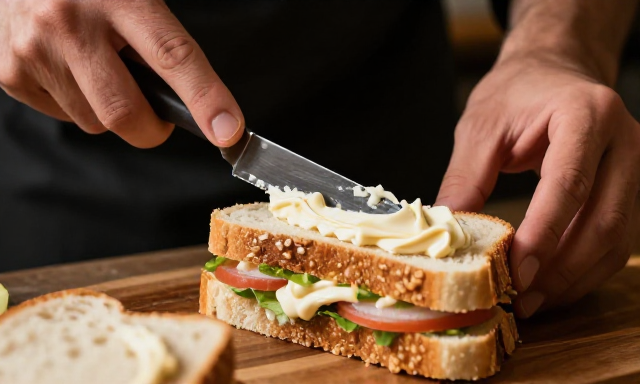
The moisture barrier is the single most impactful technique for preventing the soggy sandwich disaster that ruins packed lunches and make-ahead preparations. The principle is straightforward: fat repels water. Spreading a fat-based condiment (mayonnaise, butter, aioli, cream cheese, hummus) on both faces of the bread before adding any other ingredients creates a hydrophobic layer that slows moisture migration from wet fillings (tomatoes, pickled vegetables, dressed greens) into the bread. This is why professional deli sandwiches that sit for hours without becoming soggy are always coated on both inner surfaces — not just for flavor, but as a structural moisture management strategy.

Step by Step
  1. 1 Always apply a fat-based spread to both inner surfaces of the bread before any other ingredient
  2. 2 Apply the spread edge to edge — any uncoated area becomes a moisture entry point
  3. 3 Apply a thicker layer on the side that will contact the wettest ingredients
  4. 4 Place the driest ingredients (cured meats, cheeses) directly against the spread
  5. 5 Position wet ingredients (tomatoes, pickles, dressed greens) in the middle of the stack, away from the bread surfaces
The Science

Mayo and other fat-based spreads create a barrier because water molecules are polar and fat molecules are non-polar — they are chemically repelled. The thin layer of fat on the bread surface prevents the migration of water from wet ingredients, preserving the bread's texture for hours longer than it would otherwise last. This is not merely slowing the process; in reasonable timeframes (2–4 hours), a properly built moisture barrier can completely prevent sogginess that would otherwise develop within 30 minutes.

Common Mistakes
  • × Applying spread only to one side of bread
  • × Leaving gaps in the spread coverage — any exposed bread soaks up moisture
  • × Placing tomatoes or other very wet ingredients directly against the bread
  • × Believing that mustard alone provides an adequate barrier — mustard is water-based and provides minimal protection
Pro Tip

For maximum protection on a sandwich that will sit for hours, brush the bread with a thin layer of olive oil before the mayonnaise — the oil penetrates slightly into the bread and creates a deeper barrier.

Layering for Structural Integrity

Easy
Club Sandwiches Sub Sandwiches Tall Stacked Sandwiches

A sandwich is a structural engineering problem, and the order of layering determines whether the finished product holds together for the duration of eating or collapses into a pile of its components by the third bite. The fundamental principle is that heavy, stable items belong at the base; wet, unstable items belong in the middle; light, stable items go on top. This is not an arbitrary aesthetic preference — it reflects the physics of how forces distribute through a stacked structure under the compression of eating.

Step by Step
  1. 1 Apply moisture barrier spreads to both bread surfaces (see Moisture Barrier technique)
  2. 2 Layer cured or sliced meats directly on the bottom bread — these are structural and stable
  3. 3 Place cheese over the meat — cheese bonds to meat when warm and provides adhesion
  4. 4 Add any cooked, soft components (roasted peppers, sautéed mushrooms) next
  5. 5 Place any wet vegetables (tomatoes, pickles) in the center of the stack
  6. 6 Add fresh greens last, on top — they're light and won't compress the layers below
  7. 7 Place the top bread so it contacts the greens, not the wet center layers
The Science

When you compress a sandwich to take a bite, the force distributes from the top and bottom toward the center. Wet, mobile ingredients in the middle of the stack are subjected to compressive force from both directions — placing them at the base means they're subjected to full compression from the top and have nowhere to go but sideways, which expels them from the sandwich. In the center, wet ingredients can distribute their load to the surrounding layers rather than being expelled.

Common Mistakes
  • × Placing lettuce directly on the bottom bread — it wilts and becomes slippery under the weight of the proteins
  • × Stacking all meats on one side, creating an imbalanced structure that tilts and collapses
  • × Not pressing the sandwich lightly before cutting — a brief press melds layers and makes cutting cleaner
Pro Tip

Cut a tall, layered sandwich with a sharp serrated knife in one smooth stroke without sawing — sawing pushes layers sideways and displaces them. Chilling a complex sandwich briefly before cutting also helps the layers hold position.

The Rest Period

Easy
Muffuletta Cubanos Italian Beef Pressed Sandwiches

Resting a completed sandwich before eating is a technique borrowed from the logic of resting meat — and it produces comparably dramatic results. Certain sandwiches, particularly oil-dressed or pressed ones, improve dramatically when given time for flavors to meld, fats to redistribute, and structural elements to stabilize. A muffuletta is traditionally made the day before serving, wrapped tightly, and weighted in the refrigerator overnight. Italian beef sandwiches benefit from a 10-minute rest after assembly, allowing the jus to permeate the bread. Even a freshly pressed Cubano is better after a 5-minute rest than immediately off the press — the cheese re-solidifies slightly, binding the layers into a coherent structure.

Step by Step
  1. 1 Build the sandwich according to your recipe
  2. 2 Wrap tightly in plastic wrap (for oil-dressed sandwiches) or wax paper (for pressed sandwiches)
  3. 3 For overnight rest: wrap in plastic, place in a zip bag, place a heavy pan on top, and refrigerate
  4. 4 For short rest (10–30 minutes): wrap in paper and let sit at room temperature
  5. 5 Remove from refrigerator 15–20 minutes before serving if rested overnight
The Science

During the rest period, several processes occur. Oil and fat-soluble flavor compounds migrate from the olive salad or other dressed components into the bread, transforming the bread from a neutral carrier to an integrated part of the sandwich flavor profile. The pressed structure of the sandwich cools and the melted cheese resolidifies in the compressed position, holding the layers together mechanically. In oil-dressed sandwiches, the bread hydration reaches equilibrium — fully saturated in a way that is moist without being soggy.

Common Mistakes
  • × Not weighting the sandwich during refrigerated rest — the compression is part of the technique
  • × Resting a sandwich with fresh greens or crispy ingredients inside — these deteriorate and should be added after resting
  • × Not allowing sufficient rest time — 1–2 hours is the minimum for a muffuletta; 12–24 is ideal
Pro Tip

For the muffuletta specifically, taste a small piece of the olive salad on plain bread immediately and again after an 8-hour rest — the difference will convince you that the overnight rest is not optional.

Quick Pickles (10-Minute Pickles)

Easy
All Sandwiches Bánh Mì Smash Burgers Korean BBQ Sandwiches

Quick pickling — a 10-to-60-minute brine treatment using a hot or room-temperature vinegar solution — is one of the highest-yield techniques in the sandwich maker's toolkit. It produces vegetables that are bright, acidic, and lightly crunchy, providing the acid contrast that makes rich, fatty sandwiches balance on the palate. The acidity from quick pickles cuts through the fat of pulled pork, the richness of fried chicken, the heaviness of pastrami — in the same way that vinegar-dressed coleslaw exists not merely as a side dish but as a flavor counterpoint built into the eating experience. Quick pickles are also dramatically faster than traditional lacto-fermented pickles, and for sandwich applications, the sharper, brighter flavor of a vinegar brine is often preferred.

Step by Step
  1. 1 Combine 1/2 cup rice wine vinegar (or white wine vinegar), 1/2 cup water, 1 tablespoon sugar, and 1 teaspoon kosher salt in a small saucepan
  2. 2 Bring to a simmer over medium heat until sugar and salt dissolve — about 2 minutes
  3. 3 Slice your vegetables thin (cucumbers, radishes, red onion, jalapeños, daikon, carrots)
  4. 4 Place vegetables in a jar or bowl
  5. 5 Pour the hot brine over the vegetables
  6. 6 Let cool to room temperature (15–20 minutes) or place in the refrigerator for up to 30 minutes
  7. 7 Drain before using on sandwiches to prevent excess liquid
The Science

The vinegar in the brine is acetic acid, which denatures the cell walls of the vegetables at the surface, causing them to soften slightly and absorb the brine. The osmotic pressure of the salt draws moisture out of the vegetable cells, creating a two-way exchange: the vegetables release water and absorb brine. In 10–30 minutes, you achieve roughly the top layer of this exchange — enough to flavor and slightly tenderize the vegetables while retaining most of their crunch. Full traditional pickling over days or weeks penetrates the entire cell structure.

Common Mistakes
  • × Not slicing vegetables thin enough — thick cuts don't pickle effectively in 10–30 minutes
  • × Using too much vinegar without balancing sugar — aggressive acid without sweetness is harsh rather than bright
  • × Forgetting to drain before using — excess liquid from pickles destroys the moisture barrier in your sandwich
Pro Tip

Add aromatics to your brine: garlic, peppercorns, fresh ginger, dried chili, or fresh herbs. Even in a 20-minute quick pickle, these flavors infuse noticeably into the vegetables.

Caramelizing Onions Properly

Medium
French Dip Steak Sandwiches Burgers Grilled Cheese

Caramelized onions are one of the most frequently botched sandwich components in home kitchens, primarily because recipes that claim 'caramelize onions in 10 minutes' are lying to you. Properly caramelized onions take 45 minutes to an hour, sometimes longer, and there is no shortcut that produces the same result. The transformation is profound: a raw onion is sharp, acrid, and pungent; a properly caramelized onion is sweet, complex, jammy, and deeply savory, with a flavor profile more reminiscent of a concentrated stock than a vegetable. On a French dip or a steak sandwich, properly caramelized onions are a primary flavor driver. Any onion that takes less than 30 minutes is onion that is sweated, softened, and lightly browned — which is fine — but it is not caramelized onion.

Step by Step
  1. 1 Slice onions 1/4 inch thick pole-to-pole (through the root) — this helps them hold shape
  2. 2 Heat a wide, heavy pan (cast iron or stainless) over medium heat
  3. 3 Add 2 tablespoons butter and 1 tablespoon olive oil
  4. 4 Add onions and a pinch of salt — the salt draws out moisture and speeds initial softening
  5. 5 Cook over medium-low heat, stirring every 3–5 minutes
  6. 6 After 20 minutes, they should be soft and translucent — continue cooking
  7. 7 At 40–45 minutes, they should be deep golden-brown and jammy — taste for sweetness
  8. 8 Add a splash of white wine, balsamic vinegar, or stock at the end to deglaze if you want deeper complexity
  9. 9 Season with salt and cool before refrigerating — they keep for a week
The Science

True caramelization of onion sugars doesn't begin until around 320°F — well above the boiling point of water. During the first 20–30 minutes of cooking, the onions are releasing water and shrinking. Only after the surface moisture evaporates can the onion surface temperature rise enough to begin caramelization. Simultaneously, Maillard reactions between amino acids and sugars create hundreds of flavor compounds. Rushing this process by turning up the heat produces burned exteriors and un-caramelized interiors — the onions look browned but lack the deep sweetness of truly caramelized onions.

Common Mistakes
  • × Cooking over high heat, which burns the onions before they caramelize internally
  • × Not using enough fat — onions need fat to cook evenly without burning
  • × Stirring too frequently, which prevents the Maillard reaction from developing on the pan contact surface
  • × Stopping too early — most people stop at 'nice and brown' rather than 'deeply caramelized and jammy'
Pro Tip

Make a large batch — 6 to 8 onions at once — and store refrigerated for the week. Caramelized onions take just as long to make a small amount as a large one, and they keep beautifully.

Rendering Bacon Flat

Easy
BLT Bacon Sandwiches Club Sandwiches Breakfast Sandwiches

Bacon cooked in a pan curls, buckles, and produces an uneven, architecturally chaotic sandwich component. Bacon cooked in the oven on a rack, or with weight in a pan, renders flat and stays flat — making it dramatically easier to layer evenly, bite cleanly, and proportion correctly in a sandwich. The oven method is the preferred approach for most applications: strips laid flat on a wire rack over a sheet pan, cooked at 400°F until done, emerge flat, evenly rendered, and ready to cool on the rack (which keeps them from sitting in their own fat). The weighting method — press strips flat in a cold pan, bring to medium heat — requires attention but produces a flat strip in one pan without the oven.

Step by Step
  1. 1 Oven method: preheat oven to 400°F; line a sheet pan with foil; set a wire rack inside; lay bacon strips flat without overlapping; cook 15–20 minutes until your desired crispness
  2. 2 Pan method: lay strips flat in a cold cast iron pan; place another heavy pan on top to weight them; bring to medium heat; cook until fat renders and strips firm up; remove weights and finish to desired color
  3. 3 For extra-flat results: place strips between parchment on a sheet pan and place another sheet pan on top before putting in the oven
The Science

Bacon curls because the fat and meat layers shrink at different rates when heated — the meat fibers contract faster than the fat renders, creating differential tension that buckles the strip. Applying weight from above prevents this differential contraction from producing a curl; the physical force of the weight exceeds the tension that causes curling. Oven cooking produces more even rendering because heat comes from all directions rather than just the pan contact surface, which is why oven-cooked bacon curls less even without weighting.

Common Mistakes
  • × Starting bacon in an already-hot pan — the fast surface contact causes immediate curling before the fat has time to render
  • × Using thin-cut bacon for sandwiches that need substantial texture — go thick-cut (1/8 inch or more) for any sandwich where bacon is a primary component
  • × Overcrowding the pan or sheet pan — overlapping strips produce uneven rendering
Pro Tip

Cook bacon a full batch at a time and refrigerate — flat-cooked bacon reheats in 30 seconds in a pan or 2 minutes in a toaster oven, giving you restaurant-speed assembly for weekday sandwiches.

Proper Meat Slicing (Against the Grain)

Easy
Steak Sandwiches Roast Beef Brisket Flank Steak

Slicing cooked meat against the grain is one of the highest-impact, lowest-effort techniques in sandwich making, and it's the first thing a professional cook does automatically and many home cooks never do at all. The grain of the meat refers to the direction of the muscle fibers — you can see them as parallel lines running through a piece of raw or cooked meat. Slicing with the grain means your knife runs parallel to these fibers, producing long, stringy pieces that require significant chewing effort. Slicing against the grain means cutting perpendicular to the fibers, shortening them to the width of your slice and producing tender pieces that require minimal effort to chew. On a sandwich, the difference is stark: against-the-grain sliced flank steak or brisket is tender and juicy; with-the-grain is stringy and chewy.

Step by Step
  1. 1 After cooking, let the meat rest 5–10 minutes to allow juices to redistribute
  2. 2 Identify the grain: look at the surface of the meat and find the parallel lines of muscle fiber
  3. 3 Position the meat so the grain runs perpendicular to your knife
  4. 4 Slice thin (1/8 to 1/4 inch for most sandwich applications) in smooth, deliberate strokes
  5. 5 For large cuts like brisket that have changing grain direction, adjust your angle as you work through the piece
The Science

Muscle tissue is composed of bundles of fibers held together by connective tissue. The length of the fiber bundle you leave intact determines how much resistance you feel when biting through the meat. Slicing against the grain reduces each fiber to the thickness of a slice — 1/8 inch of connective tissue offers minimal resistance to chewing. Slicing with the grain preserves the full length of the fiber bundle, which may be 3–4 inches long in a flank steak, requiring the teeth to sever the fiber rather than just separating between them.

Common Mistakes
  • × Skipping the rest period and slicing immediately — the meat fibers need time to relax and reabsorb juices or the cut surfaces will dry rapidly
  • × Slicing too thick — thin slices have dramatically more surface area relative to volume, which means more flavor per bite on a sandwich
  • × Not adjusting for cuts that have multiple muscle groups with different grain directions (brisket, chuck roast)
Pro Tip

For flank steak specifically, cut on a bias (at a 45-degree angle) in addition to against the grain — the angled cut creates a larger surface area that reads as more tender and exposes more of the interior.

Making Aioli from Scratch

Medium
All Sandwiches Bánh Mì Po'Boys Lobster Rolls

Aioli is the Provençal emulsion of garlic, olive oil, and salt — pure, assertive, and nothing like mayonnaise despite their superficial similarity. Traditional aioli uses olive oil as its fat, which gives it a distinct flavor profile; modern versions often blend olive oil with a neutral oil for a less aggressive finish. The garlic in aioli is raw and contributes a sharp, pungent intensity that mellows only slightly in the emulsion. Understanding how to make aioli properly — and how to vary it — opens up a universe of sandwich possibilities: smoked paprika aioli for a fried chicken sandwich, tarragon aioli for a lobster roll, chipotle aioli for a torta, saffron rouille for a Provençal fish sandwich.

Step by Step
  1. 1 Grate 2–3 garlic cloves on a Microplane into a paste — the finer the paste, the smoother the final aioli
  2. 2 Place garlic paste, 2 egg yolks, 1 teaspoon Dijon mustard, and 1/2 teaspoon salt in a bowl
  3. 3 Whisk together thoroughly
  4. 4 Begin adding oil drop by drop while whisking continuously — start with neutral oil, finish with olive oil
  5. 5 After the first 2 tablespoons, you can increase to a thin, steady stream
  6. 6 Use 1 cup total oil per 2 yolks
  7. 7 Finish with lemon juice and adjust salt
  8. 8 For variations: add smoked paprika and sherry vinegar; roasted garlic instead of raw; chipotle in adobo; fresh herb puree
The Science

Aioli functions as a water-in-oil emulsion, which is the inverse of a standard emulsion — here, water droplets are dispersed in a continuous oil phase, rather than oil in water. The stabilizer is again egg yolk lecithin, but the high proportion of olive oil and the aggressive use of raw garlic create a denser, more robust emulsion than standard mayo. Traditional Provençal aioli made without egg yolks uses only the emulsifying power of the garlic proteins and the pestle's mechanical energy — an impressive and genuinely difficult technique.

Common Mistakes
  • × Using too much garlic relative to oil, producing an aioli so aggressive it overwhelms everything it touches
  • × Using 100% raw olive oil, which can turn bitter from the mechanical disruption of the emulsification process — blend with neutral oil
  • × Not using enough acid — lemon juice is essential for flavor balance and emulsion stability
Pro Tip

For a foolproof immersion blender aioli: combine egg yolks, garlic, mustard, lemon juice, and salt at the bottom of a tall narrow container; add all the oil at once; insert the immersion blender and blend without moving until the emulsion forms, then slowly raise the blender.

The Double Fry for Crispy Fried Chicken

Hard
Fried Chicken Sandwiches Nashville Hot Chicken Katsu Fish Sandwiches

The double-fry technique — frying at a lower temperature first, resting, then frying at high temperature — produces fried chicken with a crust that stays crispy for 20–30 minutes after frying, rather than going soft in 5 minutes. It's the technique behind Belgian frites (french fries cooked twice), and it applies equally well to fried chicken. The first fry cooks the interior to safe temperature without browning the exterior aggressively; the rest period allows steam to escape from the crust; the second high-temperature fry creates a deeply colored, structurally rigid crust that doesn't trap steam and go soft the way a single-fry crust does. For fried chicken sandwiches, where the chicken typically sits in a bun for a few minutes before eating, this technique is the difference between a great and a mediocre result.

Step by Step
  1. 1 Brine and bread your chicken according to your recipe
  2. 2 First fry: heat oil to 300°F; fry chicken pieces until internal temperature reaches 155–160°F, about 8–10 minutes; the exterior should be pale golden, not deeply browned
  3. 3 Remove and place on a wire rack over a sheet pan
  4. 4 Rest 5–10 minutes — do not cover; steam must be able to escape
  5. 5 Second fry: raise oil temperature to 375°F
  6. 6 Fry the rested chicken for 2–3 minutes until deep golden-brown and aggressively crispy
  7. 7 Remove and rest again on the wire rack for 2–3 minutes before assembling
The Science

During the first fry at lower temperature, the breading sets and the interior cooks, but the crust has not dehydrated fully — moisture is still trapped in the outer layer. The rest period allows this residual moisture to escape as steam, leaving the crust dry and porous. The second high-temperature fry then heats this dry, porous crust rapidly, causing the remaining water to flash to steam and create tiny bubbles within the crust — this is the physical structure responsible for extraordinary crunchiness. The high temperature also drives Maillard browning rapidly across the dehydrated surface, creating deep color and complex flavor in a short time.

Common Mistakes
  • × Skipping the resting period between fries — the rest is where the moisture escapes; without it, the second fry just produces a darker version of the same moist crust
  • × Frying at the wrong temperatures — too high on the first fry prevents the interior from cooking through; too low on the second doesn't crisp the crust
  • × Covering the resting chicken with foil — this traps steam and defeats the purpose of the rest
  • × Using oil that is too cool for the second fry, which allows the chicken to absorb oil rather than crisping
Pro Tip

Use a thermometer to monitor your oil temperature throughout the frying process — the oil drops significantly in temperature when cold chicken is added, and recovery time determines your results more than the target temperature.

Deglazing for Pan Sauces (French Dip Au Jus)

Medium
French Dip Hot Beef Sandwiches Pork Sandwiches Mushroom Sandwiches

Deglazing is the technique of adding liquid to a hot pan after searing or roasting to dissolve and incorporate the browned, caramelized bits stuck to the pan surface — the fond. These concentrated bits of protein and sugar contain enormous amounts of flavor, and dissolving them into a liquid creates the basis for a pan sauce or au jus with a depth of flavor that no amount of seasoning can replicate in a fresh liquid. For French dip sandwiches, the au jus made from deglazing the pan used to cook the beef is what transforms the sandwich from a roast beef sandwich with broth to something genuinely restaurant-quality.

Step by Step
  1. 1 Sear or roast your protein in a heavy pan until well browned — do not skip the browning stage, as the fond is essential
  2. 2 Remove the protein and let it rest
  3. 3 Pour off most of the fat from the pan, leaving a thin film
  4. 4 With the pan over high heat, add your liquid: wine, stock, beer, or water
  5. 5 Immediately begin scraping the bottom of the pan with a wooden spoon — the fond will dissolve into the liquid
  6. 6 Continue stirring and scraping until the pan is clean and the liquid has reduced slightly
  7. 7 Add stock if more volume is needed; simmer to desired consistency
  8. 8 Season aggressively with salt; add fresh herbs or a pat of cold butter to finish
The Science

The fond consists of proteins that have undergone the Maillard reaction and caramelized sugars — both classes of compounds are highly water-soluble when heated. Adding liquid creates temperature shock that causes the fond to release from the pan surface, and stirring incorporates it into the liquid. The resulting sauce contains Maillard-reaction flavor compounds (hundreds of aromatic molecules created during browning), caramelized sugars, dissolved minerals, and protein fragments — a complexity that can't be achieved with fresh ingredients alone.

Common Mistakes
  • × Not browning the protein sufficiently before deglazing — the fond is the entire point; pale meat produces pale, bland fond
  • × Adding cold liquid to a very hot pan too quickly, causing dangerous spattering
  • × Not scraping thoroughly — every browned bit left on the pan is flavor lost
  • × Under-reducing the final sauce, producing a thin, watery au jus rather than a concentrated one
Pro Tip

For French dip specifically, deglaze with red wine first (the alcohol dissolves fat-soluble flavor compounds that water cannot), reduce by half, then add beef stock for the final volume.

Building Compound Butter

Easy
Steak Sandwiches Lobster Rolls Grilled Bread Hot Sandwiches

Compound butter — butter mixed with aromatics, herbs, cheese, citrus, or other flavor elements — is one of the fastest ways to add sophisticated flavor to a sandwich. A pat of herb butter melting on a just-grilled steak before it goes into the sandwich, a garlic-parsley butter painted on sourdough before the broiler, a blue cheese butter on a steak sandwich bun — these single additions transform the flavor profile of the finished sandwich in ways that are out of proportion to the simplicity of the technique. Compound butter is also a brilliant make-ahead element: you can make a log of it, refrigerate or freeze it, and cut off rounds as needed for weeks.

Step by Step
  1. 1 Allow 1 stick (8 tablespoons) unsalted butter to soften to room temperature — it should be pliable but not melted
  2. 2 Place butter in a bowl and mix with a fork or spatula until smooth
  3. 3 Add your flavorings: herbs (2 tablespoons finely minced), garlic (1–2 cloves grated), citrus zest (1 lemon), spices, cheese, miso, anchovy paste, or other elements
  4. 4 Mix thoroughly until evenly distributed
  5. 5 Season with salt and taste — compound butter should be more assertive than you expect, as it will be diluted in use
  6. 6 Place butter in the center of a sheet of plastic wrap
  7. 7 Roll into a cylinder about 1.5 inches in diameter and twist the ends tight
  8. 8 Refrigerate at least 2 hours before using; freeze for up to 3 months
The Science

Butter is a water-in-fat emulsion — roughly 80% fat, 16–18% water, and small amounts of protein and sugar. When you mix aromatic compounds into this fat, they dissolve into the continuous fat phase, which is an excellent solvent for the fat-soluble flavor compounds in herbs, spices, garlic, and citrus zest. When the compound butter melts on a hot surface or sandwich component, it releases these concentrated flavors directly into the fat coating the food — a more efficient flavor delivery mechanism than adding the same herbs as a fresh garnish.

Common Mistakes
  • × Using butter that's too cold — it won't incorporate flavors evenly; or too warm — it will separate
  • × Under-seasoning — compound butter that seems aggressively salty when tasted alone will be well-seasoned in use
  • × Not letting it chill before cutting — room-temperature compound butter falls apart when sliced
Pro Tip

Miso compound butter is one of the most versatile options for savory sandwiches: mix 2 tablespoons white miso with 1 stick butter, add a touch of sesame oil and grated ginger — it pairs with chicken, beef, vegetables, and fish.

Blooming Spices in Fat for Sandwich Seasonings

Easy
Spiced Spreads Curried Chicken Salad Spiced Compound Butters Marinades

Blooming spices — heating dried spices briefly in fat before incorporating them into a dish — is the technique that makes the difference between a curry that tastes like a grocery store sauce and one that tastes like a restaurant dish. The principle is simple: many of the aromatic compounds in spices (turmeric, cumin, coriander, paprika, garam masala) are fat-soluble, not water-soluble. Raw dried spice added to a water-based sauce releases only its water-soluble flavor compounds; the same spice bloomed briefly in butter or oil releases both water- and fat-soluble compounds, producing dramatically more complex and rounded flavor. For sandwich seasonings — spiced aioli, curry-spiced chicken salad, harissa butter, seasoned spread bases — blooming spices first and allowing them to cool before mixing into the base produces a measurable improvement in depth and complexity.

Step by Step
  1. 1 Measure your spices before beginning — blooming happens fast and you won't have time to measure once the fat is hot
  2. 2 Heat 1–2 tablespoons of butter or neutral oil in a small pan over medium heat
  3. 3 Add spices when fat is hot — they should sizzle gently on contact, not aggressively
  4. 4 Stir constantly for 30–60 seconds — you'll see color change and smell a dramatic intensification of aroma
  5. 5 Remove from heat immediately and pour into your base (mayonnaise, softened butter, yogurt, cream cheese)
  6. 6 Allow to cool slightly before tasting and adjusting
The Science

Spice flavor compounds generally fall into two categories: volatile aromatic compounds that evaporate into the air (what you smell in raw spice) and more complex flavor compounds locked in the plant cell structure. Heat in fat does two things simultaneously: it ruptures the cell walls of the dried spice particles, releasing the fat-soluble compounds within, and the fat itself dissolves and carries these compounds into the final dish. Raw spice mixed into a sauce releases its water-soluble surface compounds quickly and its fat-soluble interior compounds only slowly, if at all — which is why bloomed spice in fat tastes so much deeper and more complex.

Common Mistakes
  • × Heating the fat too high, which burns the spices in seconds and produces a bitter, acrid result
  • × Blooming for too long — 30–60 seconds is sufficient; extended blooming depletes rather than concentrates flavor
  • × Using stale spices — blooming cannot resurrect a spice that has been sitting in the cabinet for four years; if it doesn't smell intense raw, it won't bloom into anything useful
Pro Tip

Bloom your spices and then drizzle the fragrant fat directly over a finished sandwich — a drizzle of cumin-bloomed butter over a lamb sandwich or paprika-bloomed oil over a fried egg sandwich adds a remarkable finishing note.