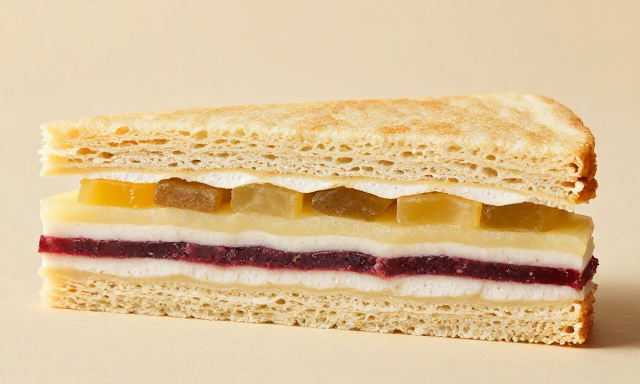
The study, titled "Moisture Migration in Multilayer Bread Assemblies," was conducted over 18 months at Wageningen University's food physics laboratory in the Netherlands. The researchers assembled 2,400 test sandwiches with controlled variables — bread type, filling moisture content, spread type, and assembly order — then measured structural integrity at 30-minute intervals over six hours.
The headline finding will surprise some: the conventional advice to spread condiments (mayo, mustard, butter) directly on the bread as a moisture barrier is correct — but only if the condiment is applied to both slices. A barrier on one side reduces sogginess by 23%. A barrier on both sides reduces it by 61%. More surprisingly, the study found that placing the wettest ingredients (tomatoes, cucumbers, pickled items) in the center of the sandwich stack — surrounded by drier ingredients like cheese, meat, and lettuce on either side — slows moisture migration by an additional 34% compared to placing wet ingredients adjacent to the bread.
"The physics are straightforward: moisture moves along concentration gradients," said the study's lead author. "If you create a distance between the wet ingredient and the bread, even a few millimeters of drier material, you interrupt the pathway significantly. The bread sees much less total moisture over the same time period."
The practical upshot, translated from science into kitchen terms: mayo on both bread slices, then your cheese directly on the mayo, then your meat, then your tomatoes or pickles in the center, then lettuce (which also acts as a partial moisture barrier) between the wet items and the top bread. Assemble this way and your sandwich stays structurally sound for 2–3 hours instead of 30–45 minutes.
Original Source
This story was reported by Science of Food Journal. Read the original article →