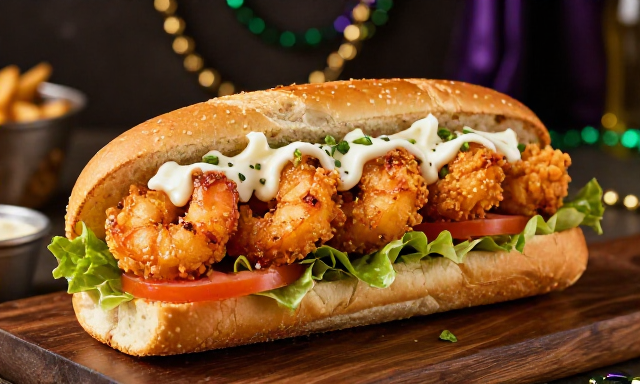
The origin story has the clarity of myth, which is appropriate because it is also essentially true. In 1926, Benny and Clovis Martin — former streetcar conductors turned restaurant owners — pledged to feed striking New Orleans streetcar workers for free during a bitter labor dispute. When a striker came in for a meal, someone in the kitchen would call out "here comes another poor boy." The free sandwich of the moment — roast beef on French bread — became the "poor boy," then the po'boy, then one of the most iconic regional sandwiches in American culinary history. The centennial of that moment falls in 2026, and New Orleans is treating it as the civic occasion it deserves.
The po'boy's essential character was fixed early by the bread. New Orleans French bread is distinct from Parisian baguette in a specific way: it has a thin, shattering crust and an exceptionally light, almost cloud-soft interior. The combination — crunch outside, yielding inside — is what makes a po'boy work as a sandwich format. Every filling, from roast beef debris (the scraggly, over-braised bits that fall into the au jus) to fried oysters, fried shrimp, or soft-shell crab, is designed around bread that provides contrast rather than competition.
The shops that have carried this tradition are institutions by any measure. Parkway Bakery & Tavern, which opened in 1911, survived Hurricane Katrina's floodwaters — the kitchen was underwater, the ovens were destroyed — through a combination of community fundraising, a famous dedication to reopening, and the raw stubbornness of owner Jay Nix. Parkway reopened in 2009 and is now one of the most-visited sandwich destinations in the American South. Domilise's on Annunciation Street, a cash-only operation that looks precisely like it did in 1948, serves fried shrimp po'boys that regulars describe with the specific reverence usually reserved for family recipes. Mahony's, the newer addition to the canon, has pushed the format into more adventurous territory without abandoning the fundamentals.
The centennial debate the city is having — roast beef debris vs. fried seafood as the defining po'boy filling — is, of course, not really a debate. Both are correct. The dressed specification ("dressed" means lettuce, tomato, mayo, and pickles, standard unless you ask for "undressed") applies equally to both. What the debate reveals is the sandwich's extraordinary adaptability: a century of the same format, the same bread, the same dressing code, producing an argument that hasn't been resolved and shows no signs of resolution.
Hurricane Katrina in 2005 nearly ended the po'boy tradition. Dozens of legacy shops closed permanently. The ones that survived — and the ones that opened in the recovery years — are now understood as cultural infrastructure in a way that goes beyond food. When New Orleans rebuilt its po'boy culture after 2005, it was rebuilding something it understood to be essential. The centennial, then, is not just a birthday. It is a proof of survival.
Original Source
This story was reported by New Orleans Times-Picayune. Read the original article →